


What remains unclear for many teams is something else entirely. What happens after the prototype — when the first excitement fades and the system has to live in the real world?
The Pioneer Phase
The first phase of generative AI was shaped by pioneers: Fast experiments. Lightweight solutions. Small scripts, notebooks, ad-hoc services — frequently developed outside established engineering workflows and governance structures. For many teams, this phase felt liberating. Ideas could be tested without friction. Results appeared quickly.
That phase mattered. It exposed real potential and lowered the barrier to experimentation in a way few technologies ever have. But it was never designed for long-term ownership, operational stability, or enterprise accountability.
Where Friction Begins
AI is no longer an experiment at the margins. It is now expected to become part of production systems, influence customer-facing functionality, and support critical business processes. That expectation changes everything.
AI systems are probabilistic by nature. Their behavior is harder to test, harder to predict, and harder to explain. Outputs can change without code changes. Quality becomes a matter of distributions, confidence intervals, and acceptance thresholds rather than pass-or-fail conditions.
At the same time, enterprise systems still depend on predictability, traceability, and control. Security requirements remain strict. Compliance obligations don’t soften. Operations still need clear ownership models, escalation paths, and defined failure modes.
This is where many teams feel the tension most clearly. AI doesn’t break engineering — but it stress-tests every assumption traditional software systems quietly relied on.
The Real Gap
The problem is not AI. And it is not a lack of tools, models, or frameworks.
What’s missing is a deliberate engineering approach for integrating probabilistic components into stable, secure, and maintainable software architectures. Not instead of established engineering discipline, but as a direct extension of it.
Experienced engineers already know what it means to build systems that last. They think in terms of architecture, lifecycle management, and operational responsibility rather than demos or quick wins. They care about observability, operability, versioning, and long-term cost. They design for failure, document decisions, define ownership, and work within real organizational and regulatory constraints.
AI doesn’t invalidate these principles. It makes them unavoidable.
Sign Up for Our Newsletter
Stay Tuned & Learn more about VibeKode:
What Engineering AI Actually Means
Engineering AI systems means dealing with questions that rarely surface during prototyping — often because there simply isn’t time for them yet.
It means understanding how retrieval strategies, embeddings, and context construction shape system behavior over time. It means treating RAG pipelines as first-class architectural components with clear interfaces, contracts, and failure semantics. It requires structuring outputs so systems remain observable, debuggable, and auditable — even when behavior is non-deterministic.
It also means integrating AI components into existing CI/CD pipelines, evaluation strategies, and monitoring setups, and reasoning about cost, latency, quality, drift, and operational risk as a single system rather than isolated concerns.
These are not theoretical issues. They are the questions that surface once an AI system is expected to run reliably, day after day, under real conditions.
What It Takes to Close That Gap
This gap does not close itself. It can’t be solved between meetings, or delegated to a single role, or fixed with another framework. It requires time — uninterrupted time — to connect technical mechanisms with architectural responsibility. It requires continuity, shared language, and the chance to think beyond immediate delivery pressure.
Most engineering environments rarely create space for that kind of work. Not because it isn’t important, but because it competes with everything else that already feels urgent.
Sign Up for Our Newsletter
Stay Tuned & Learn more about VibeKode:
Where the VibeKode Tour Comes In
If parts of this sound familiar, you’re likely already living with that tension.
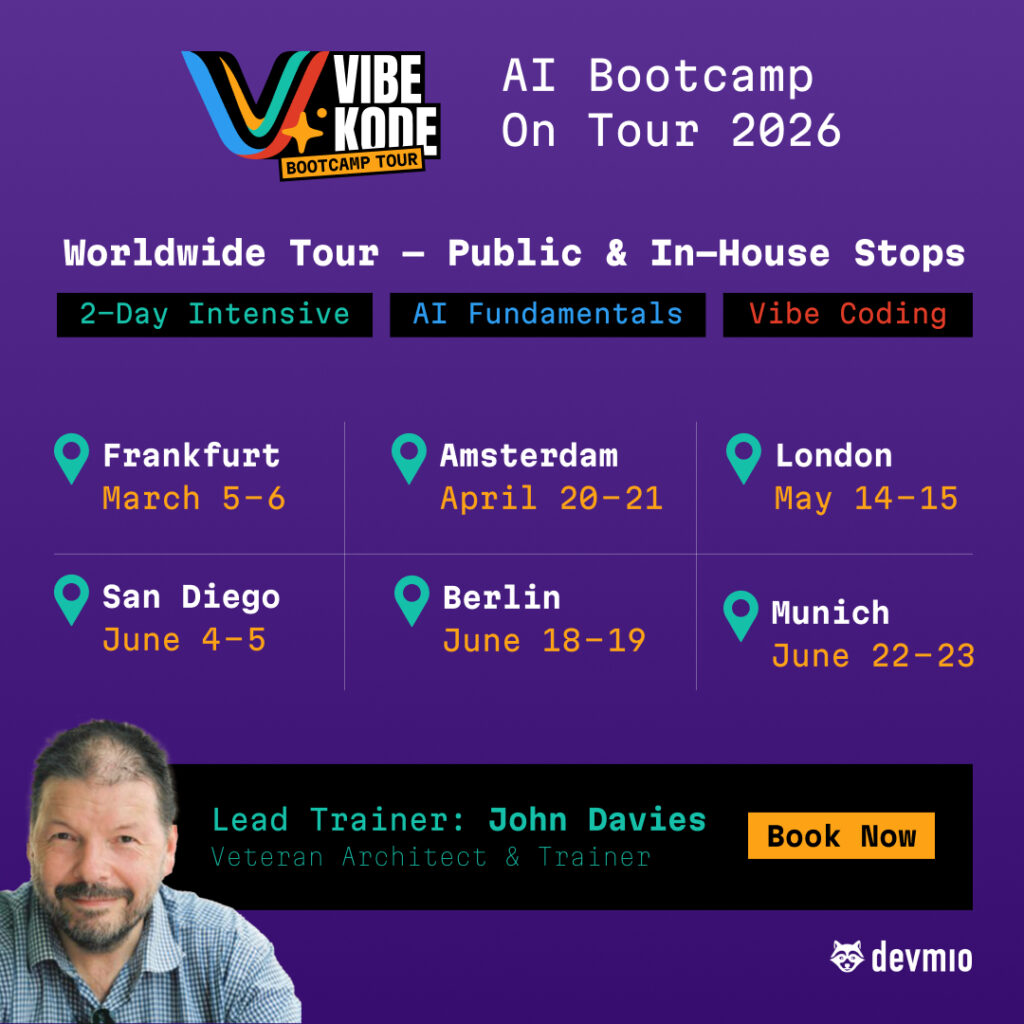
The VibeKode Tour is designed for exactly this moment. Not as an introduction to AI, and not as a catalogue of techniques, but as an engineering bootcamp in the literal sense: concentrated time, shared focus, and sustained work on questions that usually get postponed in day-to-day delivery.
What makes this possible is the format — and the person guiding it. John Davis brings decades of experience building, operating, and evolving complex enterprise systems. Not as theory, but as practice. He understands where architecture breaks under pressure, where responsibility becomes unclear, and where engineering decisions quietly shape long-term outcomes. Spending two full days (!) with him is not about absorbing opinions, but about sharpening judgment.
A bootcamp creates a space most engineers rarely get. Removed from daily interruptions, working with the same group over an extended stretch of time, ideas can mature instead of being rushed. Concepts connect. Assumptions get challenged. Conversations continue instead of resetting after each session. That continuity is not a side effect — it is the point.
Across stops in Frankfurt, Amsterdam, London, Berlin, and Munich, the VibeKode Tour offers exactly that kind of experience. Intense, focused, and deliberately demanding. Not to overwhelm, but to open up new ways of thinking about AI as part of real software systems.
If AI in your organization has moved beyond curiosity, but hasn’t yet become a disciplined engineering practice, two days in this environment can change how you approach the problem — and what you expect from your own work afterwards.
🔍 Frequently Asked Questions (FAQ)
1. What is the difference between AI prototyping and engineering AI systems?
Prototyping focuses on quick experimentation with models, often outside of governance or production standards. Engineering AI involves integrating these systems into stable, secure, and maintainable software architectures.
2. Why do AI systems create friction in enterprise environments?
AI's probabilistic nature introduces unpredictability, making outputs harder to test and control. Enterprises require traceability, compliance, and clearly defined operational responsibilities—often in conflict with AI system behavior.
3. What challenges emerge when moving AI into production?
Productionizing AI systems involves dealing with drift, versioning, failure modes, and monitoring non-deterministic outputs. These concerns rarely arise in early-stage prototypes.
4. Why isn’t the lack of tools the real problem?
The true gap lies in missing engineering discipline: the failure to apply architectural, operational, and lifecycle best practices to probabilistic components like RAG pipelines and embeddings.
5. What does “engineering AI” actually require?
It requires structured approaches to retrieval, context-building, observability, CI/CD integration, and risk analysis—treating AI as a system component, not a magic black box.
6. How does the VibeKode Tour help address this gap?
The VibeKode Tour is an engineering bootcamp designed to create focused time and space for teams to mature their AI systems thinking—beyond demos or tools.
7. Who is the VibeKode Tour for?
It’s for teams that have built AI prototypes but struggle to operationalize them under enterprise constraints. It’s aimed at experienced engineers looking to adapt their expertise to AI systems.
8. What is the role of operational responsibility in AI systems?
Engineering AI demands clear ownership, defined escalation paths, and documented architectural decisions—ensuring systems can run reliably and be audited over time.